
Oil & Gas Production Underground Gas Storage Carbon Capture & Storage Offshore Platforms
The extraction and injection of oil and gas into and out of the subsurface causes millimetre-scale surface displacements that can be accurately and repeatedly detected using satellites.
A Long-Term, Wide-Area and Cost-Effective Solution for Reservoir Monitoring
Mapping, measuring and monitoring surface movement with InSAR can provide insightful information into the subsurface, as well as be used as an input for reservoir model calibration.
Oil & Gas Production
Measuring surface movement over oil and gas fields not only mitigates risk to field assets and potential well breakages, but also provides measurable insights into subsurface reservoir geometries.
Improve Production Efficiency, Manage Assets and Mitigate Risk
Rapid reporting has allowed satellite monitoring to become an integral part of field operation management. Regular updates highlight atypical changes in surface motion rates that may indicate the reactivation of fault and fracture systems, or fluid migration.


InSAR Ground Deformation Mapping over Oil & Gas Operations (left to right): Enhanced oil recovery operations, Geomechanical model calibration, Heavy oil operations, SAGD & cyclic steam stimulation [Img src TRE-Altamira]
EOR Heavy Oil SAGD Cyclic Steam Stimulation Recovery Optimisation Reservoir Structure & Dynamics Fault & Fracture Systems Caprock Integrity HSE Compliant
InSAR data can be integrated into reservoir models and used to optimise recovery, providing information for operators to analyse steam chamber expansion and caprock integrity. Satellite monitoring also improves site safety and reduces potential damage to assets by monitoring displacement around injection and production wells.
Underground Gas Storage
Accurately monitor the seasonal uplift and subsidence ground response cycles over underground gas storage sites and analyse the gas volume stored vs. surface displacement dynamic to potentially increase stored gas volumes.
When coupled with injection and extraction rates, displacement measurements can be used as an input to geomechanical models to estimate reservoir volume and pressure changes over time, ensuring that safe operational limits are maintained and gas storage strategies optimised.

Underground Gas Storage Monitoring: The storage of gas in underground reservoirs produces seasonal surface displacements that can be accurately measured. Surface movement can be correlated with gas injection volumes to calibrate geomechanical models and to estimate reservoir volume and pressure changes over time [Img src TRE-Altamira]
Carbon Capture & Storage
InSAR provides a long-term monitoring solution for reservoir integrity and detecting millimetre changes in surface movement related to CO2 storage.
Regular reporting allow site engineers to monitor injection activities and ensure reservoir pressure and surface uplift remain within operational limits. Maps highlight CO2 plume propagation and by integrating InSAR data with subsurface models, reservoir volume and permeability changes can be calculated.
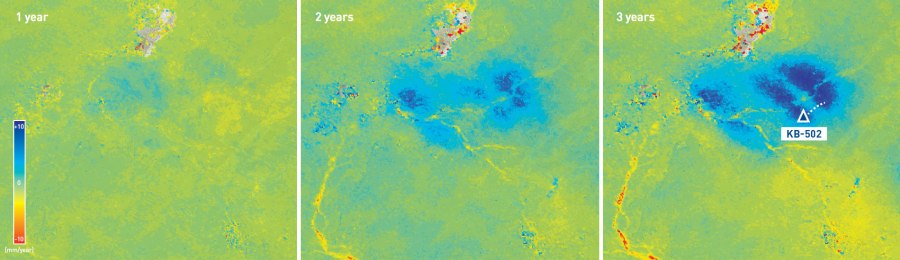
Carbon Capture & Storage Monitoring: Accurately measure ground response to CO2 injection and storage at CCS sites and identify plume migration. Measurements can be incorporated into subsurface models to calculate reservoir volume and permeability changes over time [Img src TRE-Altamira]
Offshore Platforms
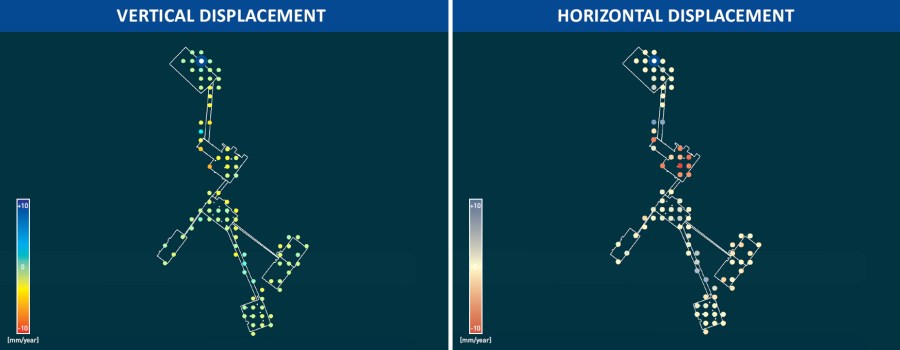
High-resolution radar satellites can clearly identify thousands of measurement points over offshore oil platforms, allowing platform subsidence and tilt to be quantified, with no instrument installation required.
Differential displacements can be calculated between platform clusters, as well as providing time-series of displacement. By using additional GPS data, both absolute and differential settlement rates can be provided. Large offshore structures and artificial islands are particularly suitable for this kind of analysis.
 Global Remote Sensing